Generic vs Domain Specific Tokenizer Eval
Overview
An LLM does not understand the words as humans do. For an LLM, everything is a token, which is created by the Tokenizer. The Tokenizer splits input text into tokens and assigns an id to each token, which is called the token id. This process is called tokenization.
These tokens then pass through the embedding layer, where the LLM accesses the embedding values of the token id.
A simple flow to understand tokenization is this:
FYI: the process explained here is for a trained tokenizer and a trained model, not during training.
So, every token is represented as an embedding vector and the LLM needs to process it. More tokens mean more computation cost. So we need an efficient tokenizer, one that covers the same text in fewer tokens.
Tokenizer Training
A tokenizer is trained before it is used. During training, it learns how to create tokens.
We give it two things. First, a corpus, which is just a pile of text, the dataset we train the tokenizer on. Second, how many tokens it is allowed to keep. That second number is the vocabulary size.
Training gives us back two things too: the list of tokens, and the rules for splitting text into them.
The tokenizer picks its tokens by looking at the corpus we gave it. Words that show up often become one token. Rare words get split into smaller tokens. So the tokens a tokenizer ends up with depend on one thing: the corpus it was trained on.
There is a mathematical way to measure the efficiency of a tokenizer. The average number of tokens per word is called fertility. The ideal fertility is 1, which is only theoretical. Normally it is around 1.2.
Rule of thumb: Lower the fertility, better the tokenizer.
Generic Tokenizer
Claude and GPT use generic tokenizers. Their corpora were general text from the web. That is the right choice for them, because most text people send an LLM is general text, and on general text these tokenizers are very good. GPT-4’s tokenizer has a fertility of 1.173 there, which is close to one token per word.
The trouble starts when your input text is not general text. On medical writing the same tokenizer has a fertility of 1.496. Same tokenizer, harder text, more tokens. The reason is the corpus. Medical words are rare on the web, so the tokenizer has no token for them, and has to build them from smaller tokens it already has.
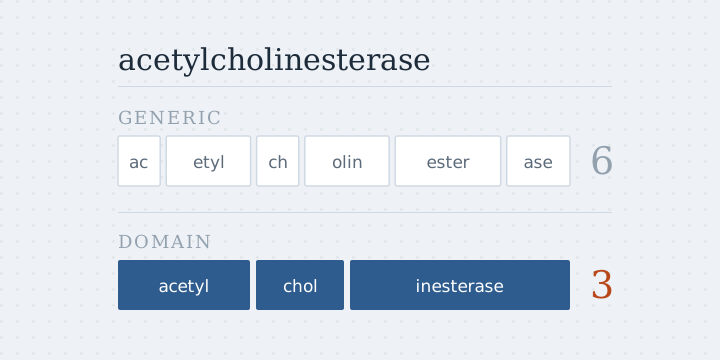
Here is what GPT-4’s tokenizer does with two medical words:
| word | tokens | how it is split |
|---|---|---|
acetylcholinesterase | 6 | ac etyl ch olin ester ase |
glomerulonephritis | 5 | glomer ul one ph ritis |
Six tokens for one word.
Now look at the second one. That one in the middle
is the English word one. It is there because one is common on the web, not
because it means anything in a kidney disease. The tokenizer is not reading
medicine. It is rebuilding a medical word out of leftovers from everyday
English.
So what does this lead to? It leads to a large number of tokens, and more tokens mean more computation cost.
Can a domain specific tokenizer fix this? Let us not assume it. We will train
two tokenizers, custom-med-bpe and custom-general-bpe, and find out.
Training Two Custom Tokenizers to Evaluate
Why two, when we only care about the medical one? Because we are about to say that medical training is what makes the medical tokenizer good. To show that, we need something identical in every other way to compare against. Same code, same vocabulary size, same settings. Only the corpus is different.
So custom-med-bpe is trained on PubMed abstracts, and custom-general-bpe
is trained on Wikipedia paragraphs. The second one is
called the control, which means it exists only to be compared against. If the
two differ on medical text, the corpus is the only thing that could have caused
it.
The configuration
| setting | value |
|---|---|
| medical corpus | 200,000 PubMed abstracts |
| general corpus | 383,894 Wikipedia paragraphs |
| corpus size | 282 million characters each |
| held out for testing | 20,000 abstracts and 38,389 paragraphs |
| vocabulary size | 16,000 |
| sampling | random, fixed seed |
The two corpora hold the same amount of text on purpose, so neither tokenizer gets more to learn from than the other. We then test both of them twice, once on held-out abstracts and once on held-out paragraphs. Neither tokenizer had seen either set during training.
The code and the full results are here: github.com/viveshy/domain-tokenizer-eval.
Results
After training both tokenizers, we compared them against the two generic
tokenizers people actually use every day: cl100k from GPT-4 and o200k from
GPT-4o. All four were tested on the same held-out abstracts and paragraphs, and here
are the outcomes.
| tokenizer | vocabulary | fertility on medical text | fertility on general text |
|---|---|---|---|
custom-med-bpe | 16,000 | 1.484 | 1.478 |
custom-general-bpe | 16,000 | 1.831 | 1.197 |
cl100k (GPT-4) | 100,277 | 1.496 | 1.173 |
o200k (GPT-4o) | 200,019 | 1.467 | 1.163 |
Remember the rule: lower is better. Read the medical column first, then the general one. Our medical tokenizer is second best on medical text and last on general text. That flip is the whole story.
Conclusion
Three things come out of this.
Domain matters more than size. Our 16,000-token medical tokenizer has a fertility of 1.484 on medical text. GPT-4’s has 1.496, with six times the vocabulary. Where the tokens came from mattered more than how many there were.
Size is not the explanation. Look at the two 16,000-token rows. Same code, same size, same settings. One has 1.484 and the other 1.831. Tokenizers of the same size cannot differ because of size, so the corpus is the only thing left.
Specialising costs you elsewhere. On general text our medical tokenizer is the worst of the four, at 1.478. A vocabulary is a fixed budget, and ours spent it on medical words. That is not a bug. It is the proof that it specialised.
One honest note. Our tokenizer beats GPT-4’s at 16,000 tokens, but it does not beat GPT-4o’s, which has 1.467. It needs 32,000 tokens to do that.
When to Use Which
Use a generic tokenizer for general work. That is most work, and generic tokenizers are very good at it.
Train your own when your input text has its own vocabulary and you handle a lot of it. Medical, legal, chemistry, code. The narrower your text, the more a generic tokenizer spends on tokens you never use.
Do not bother for a small amount of text. At 16,000 tokens our medical tokenizer saves about 2 tokens on a 200-word abstract, compared to GPT-4’s. That only becomes real money when you are processing millions of them.